All Categories
Featured
Indicators on Unsecured Debt Forgiveness Pathways You Sho...
How What the Law Says While Undergoing Debt Relief can Sa...
The Single Strategy To Use For Understanding Your Legal O...
Getting The Understanding Your Legal Options in Bankruptc...
Browsing Financial Obligation Forgiveness in 2026: Finding Legitimate Relief in a Crowded Market
Table of Contents
When bank card equilibriums spiral beyond control and monthly minimal payments barely damage the surface of what you owe, the weight of financial tension can feel intolerable. With American consumers now holding over $1.21 trillion in credit history card financial obligation collectively, discovering reputable debt relief has never ever been extra vital. Nearly half of cardholders bring a balance from month to month, and the part dropping behind on minimal settlements has climbed to 12.3% in recent information.
For those seeking a pathway out of overwhelming financial debt, understanding the distinction in between debt forgiveness, insolvency therapy, and financial debt monitoring can suggest the distinction between financial recuperation and much deeper difficulty.
What Debt Forgiveness In Fact Means
Financial obligation forgiveness refers to the process of working out with lenders to minimize the overall quantity owed, permitting consumers to settle their financial debts for much less than the original balance. Unlike debt combination, which incorporates several financial debts into a single repayment, or financial obligation management intends that restructure payment routines, debt mercy programs proactively work to eliminate parts of your exceptional balances.
When a charge card account goes unsettled for 120 days or more, creditors often bill off the debt and may approve decreased negotiations to recover at the very least a part of what they're owed. Negotiations normally vary from 30% to 50% of the original balance, though results differ based on the financial institution, account age, and individual situations. Many financial obligation forgiveness programs cover two to 4 years, calling for clients to develop funds in dedicated accounts while negotiators deal with financial institutions.
It's worth noting that forgiven financial debt over $600 is generally considered taxable earnings by the internal revenue service. Anyone considering financial obligation negotiation ought to get in touch with a tax obligation professional to understand the effects before continuing.
The Important Difference Between Nonprofit and For-Profit Solutions
The Consumer Financial Security Bureau advises that taking care of for-profit financial debt negotiation companies can be dangerous. These companies generally bill costs varying from 15% to 25% of registered financial obligation and frequently motivate customers to quit paying entirely while arrangements continue. This strategy can result in mounting late costs, fine rate of interest charges, harmed credit history, and also suits from lenders.
Nonprofit credit scores counseling agencies run under various standards. Organizations authorized by the U.S. Department of Justice as 501(c)(3) nonprofits concentrate on customer welfare instead of earnings margins. Their credit history therapy sessions are normally provided totally free of charge, and financial obligation management program charges are topped at $79 regular monthly across the country under federal regulations.
The National Foundation for Debt Therapy (NFCC), started in 1951, represents the gold requirement for not-for-profit economic therapy. NFCC participant companies should fulfill rigorous moral standards, with counselors needed to recertify every 2 years. Research carried out by Ohio State College discovered that NFCC credit therapy customers minimized their revolving debt by $3,600 greater than comparison groups over 18 months following therapy, with 70% reporting enhanced economic confidence.
Bankruptcy Counseling: Comprehending Your Legal Demands
For individuals whose financial situations have actually deteriorated past what financial obligation forgiveness or monitoring programs can deal with, personal bankruptcy might become necessary. Federal legislation requires anybody declare Phase 7 or Phase 13 bankruptcy to finish both pre-filing credit score therapy and post-filing debtor education and learning programs with an accepted agency.
Pre-bankruptcy therapy includes a detailed review of earnings, financial obligations, and expenses, in addition to exploration of choices to personal bankruptcy. The session helps filers comprehend whether personal bankruptcy truly represents their ideal alternative or whether various other debt alleviation approaches may work. Post-filing borrower education focuses on budgeting, conserving, and restoring credit rating after insolvency discharge.
Both sessions typically take 60 to 90 minutes. Charges differ by carrier yet usually array from $20 to $50 per program, with charge waivers available for those that qualify based upon revenue. Upon completion, filers receive certifications needed for their bankruptcy petitions.
Not-for-profit companies like APFSC offer these called for personal bankruptcy counseling courses alongside their various other financial debt alleviation solutions, providing a structured experience for those navigating the personal bankruptcy procedure.
Comparing Your Financial Debt Relief Options
Understanding which approach fits your scenario requires truthful assessment of your economic situations.
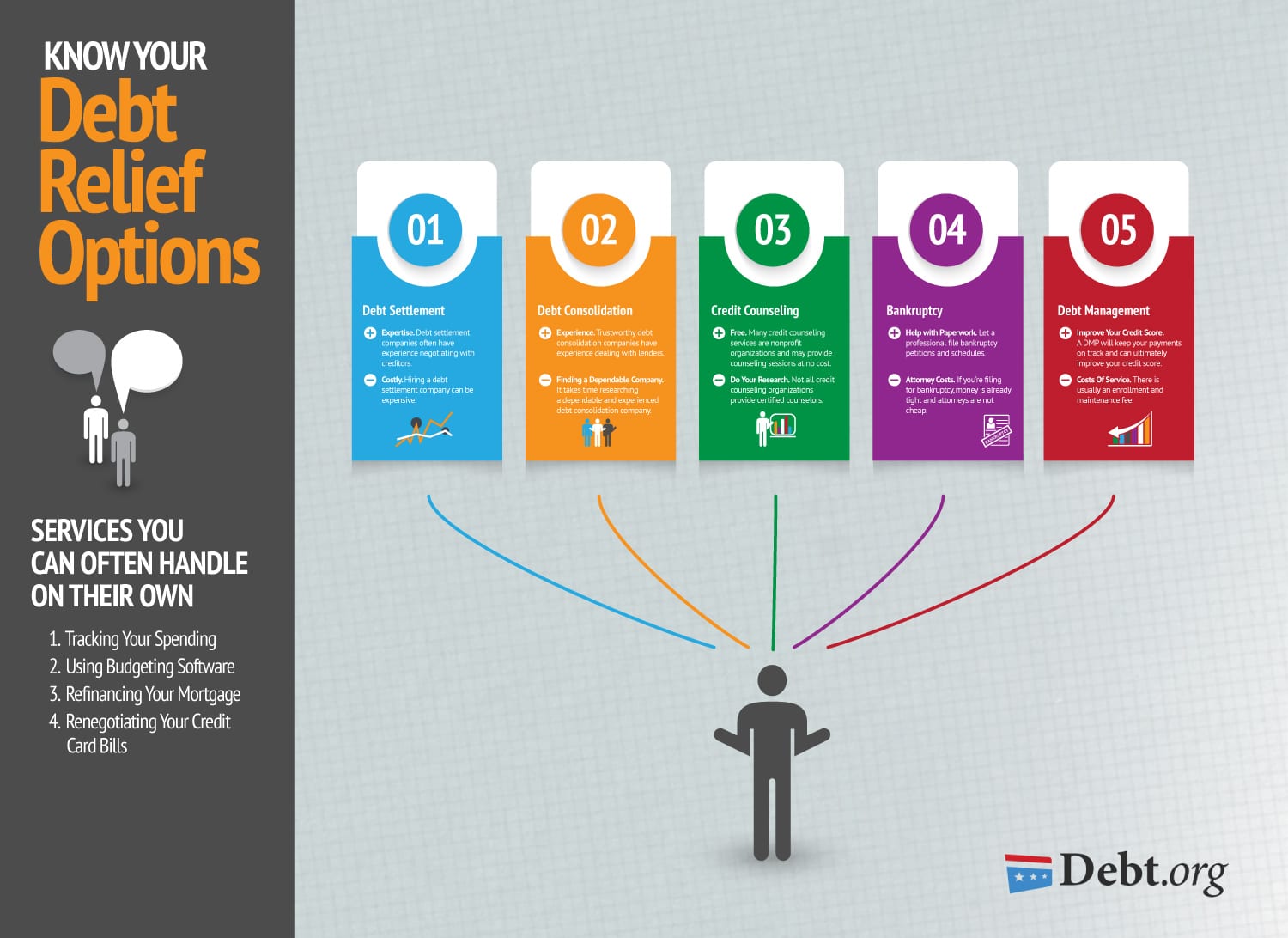
Financial debt administration intends job best for those who can still make regular repayments yet require helping in reducing rates of interest and organizing several debts right into single regular monthly repayments. These programs typically cover 3 to 5 years and pay financial obligations completely, simply with better terms. Credit history usually enhance over time as equilibriums decrease.

Financial obligation settlement or mercy programs suit those with larger financial debt lots, generally $7,500 or even more, that have already fallen back on settlements and can not reasonably pay equilibriums in full. These programs bargain decreased payoffs yet carry credit report score consequences and tax effects.
Bankruptcy offers the most significant relief yet additionally the most substantial lasting credit effect. Phase 7 liquidates possessions to release financial debts, while Phase 13 produces structured repayment plans over 3 to 5 years. Bankruptcy remains on credit rating records for 7 to 10 years.
Credit score therapy alone, without enrollment in a specific program, assists those who require budgeting advice and financial education to avoid future debt issues. These sessions are typically cost-free via not-for-profit companies.
Indication of Financial Obligation Relief Scams
Consumers ought to be specifically skeptical of firms asserting to provide government-sponsored credit rating card debt forgiveness programs. No such federal programs exist for charge card financial obligation, unlike the mercy options readily available for government trainee loans. Any type of ads suggesting otherwise are likely frauds.
Various other red flags include business that demand huge upfront costs before supplying services, assurance certain settlement portions, inform you to quit connecting with financial institutions totally, or refuse to explain their fee framework clearly. Genuine nonprofit firms offer clear details about expenses, timelines, and reasonable results.
The CFPB recommends taking into consideration all choices before engaging any financial obligation relief solution, including working out straight with financial institutions on your own and talking to not-for-profit credit counselors who can supply objective assessments of your situation.
Making an Informed Choice
Choosing the appropriate financial debt relief course relies on private conditions, complete financial debt quantity, revenue security, and ability to make constant repayments. Free preliminary consultations from not-for-profit credit scores counseling firms assist potential customers comprehend their options without high-pressure sales techniques.
Throughout these sessions, licensed therapists examine economic circumstances, clarify readily available programs, and establish customized suggestions. Whether someone ultimately selects financial debt forgiveness, financial obligation monitoring, bankruptcy, or self-directed payment, beginning with not-for-profit advice ensures they receive recommendations concentrated on their financial wellbeing.
Industry leaders like Finance International, GreenPath Financial Wellness, InCharge Financial Obligation Solutions, and APFSC all supply thorough solutions spanning credit scores therapy, debt monitoring, and bankruptcy education and learning. Most supply numerous contact techniques consisting of phone, on the internet conversation, and e-mail, making it very easy to start the discussion.
Taking the Very First Step
Financial recuperation seldom happens over night. Financial obligation monitoring plans normally span 3 to 5 years, and debt settlement programs typically call for 24 to 48 months of organized cost savings and settlements. The choice of continuing to struggle with uncontrollable financial debt while rate of interest compounds offers no path forward.
For anyone sinking in credit history card financial obligation, medical costs, or individual fundings, reaching out to a nonprofit credit history therapy company stands for an essential initial step. The examination costs nothing, lugs no obligation, and provides clearness concerning reasonable options. From there, educated decisions end up being possible.
Specialty Counseling Services : APFSC Tailored Financial SupportThe journey from overwhelming financial obligation to economic security calls for commitment, persistence, and professional assistance. With support from relied on nonprofit companies and a clear understanding of offered programs, that trip comes to be possible.

Table of Contents
Latest Posts

Indicators on Unsecured Debt Forgiveness Pathways You Should Know
How What the Law Says While Undergoing Debt Relief can Save You Time, Stress, and Money.
The Single Strategy To Use For Understanding Your Legal Options Regarding How Debt Counseling Helps You Tackle Debt Effectively : APFSC
More
Latest Posts
Indicators on Unsecured Debt Forgiveness Pathways You Should Know
How What the Law Says While Undergoing Debt Relief can Save You Time, Stress, and Money.